
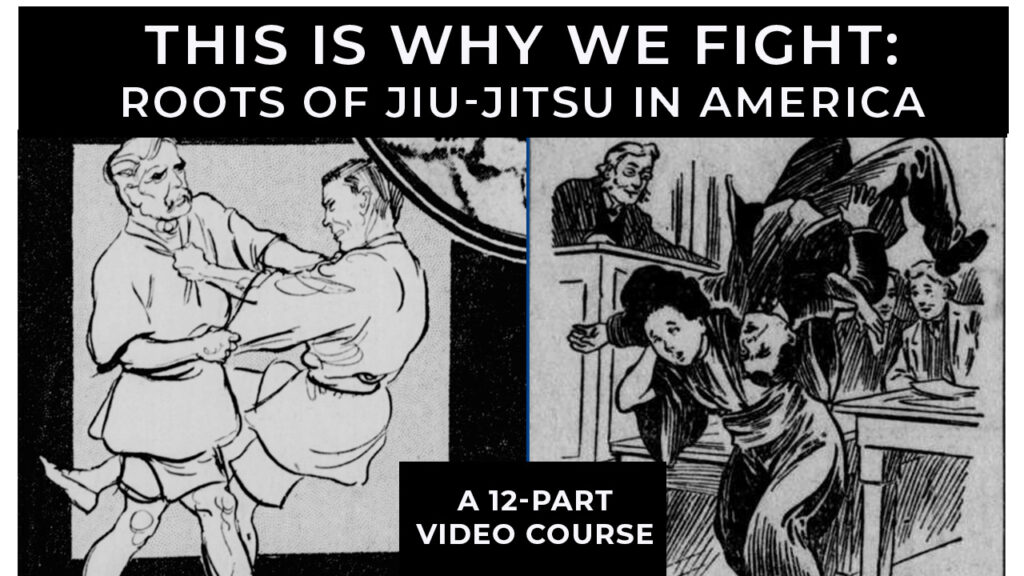
The way we fight tells us who we are. Jiu-jitsu didn’t simply “arrive” in America. It traveled—through immigration and empire, journalism and advertising, presidential politics, gender activism, street violence, vaudeville stages, military training rooms, and eventually the fight circuits of Brazil. This course follows that story from 1600 through 1914, focusing on the moment when jiu-jitsu became a cultural force in the United States.
I’m teaching a class at Western Washington University this winter that explores the distribution of modern martial arts throughout the world, starting in 1600, and covers the way those arts transform the world and are transformed by it … and I’m adapting that class for online education, to make sure people from all around the country who are interested can have access to lectures, text, video, audio, art and other materials we’ll be studying over the course of the term.
It’s available for purchase now at BJJMentalModels.com/fight . Register by Dec. 7 for the lowest possible rate! The first video is online now. We’ll post classes weekly, starting Dec. 8 until all 12 classes are online.
Our goal is simple:
To look at jiu-jitsu as an example of martial art that changed the world, and a representation of why martial cultures develop—and what those choices reveal about the societies that practice them.
Whether you’re a practitioner, coach, historian, journalist, artist, or curious observer, you’ll find multiple ways to engage. You can watch the lectures on their own or dive deeper into the historical PDFs, letters, articles, and optional readings.
The course is designed to meet you where you are. Again, welcome.
How the Course Works
Each of the 12 classes includes:
- A recorded video lecture (downloadable)
- Optional transcripts for accessibility and offline reading
- Primary-source packets in PDF format (letters, newspaper articles, cartoons, archival excerpts)
- A discussion thread where you can ask questions or respond to others
- Supplemental reading, viewing, and listening for deeper study
You can move through the material at your own pace. Nothing expires.
If you have questions, notice errors, or want to share further sources, email jeff@bellinghambjj.com or post in the comments attached to each class.
What You’ll Learn (Class Titles)
Below are the 12 modules you’ll encounter:
1. Origins Are a Knife Fight
In 1600, the Battle of Sekigahara established the Tokugawa Shogunate, launching more than two centuries of relative peace—an era in which combat arts evolved away from battlefield necessity and into systems of personal cultivation, civilian defense, and school-based discipline. In this class, we examine how “jūjutsu” emerged from multiple regional lineages, why its origin story resists simple timelines, and how early-modern Japanese politics shaped what counted as legitimate martial knowledge.
Read: Excerpts from “The Way of Judo: A Portrait of Jigoro Kano and His Students,” by John Stevens. “Judo Memoirs of Jigoro Kano,” translated by Brian Watson.
2. The House That Kano Built
In 1882, a young educator and statesman named Jigoro Kano opened the Kodokan in a tiny space in Tokyo. Within decades it became one of the most influential martial institutions in the world. This class explores how Kano blended traditional jūjutsu with modern physical education, why “judo” became the chosen term, and how concepts like randori, kata, and jita kyoei (“mutual welfare and benefit”) helped redefine what martial arts could be in an industrializing nation.
Read: Excerpts from “The Way of Judo: A Portrait of Jigoro Kano and His Students,” by John Stevens. “Judo Memoirs of Jigoro Kano,” translated by Brian Watson.
Watch: Jigoro Kano teaching judo (from kito-ryu jūjutsu)
3. When the World Tilted West
Between 1900 and 1904, as Japan and Russia clashed over territory and influence, Americans became fascinated with the rumored “secret techniques” behind Japan’s unexpected military victories. At the same time, a railroad magnate, a former police constable, and a network of ambitious jiu-jitsu instructors were introducing the art to U.S. audiences from New York to Seattle. This class traces the people, headlines, and geopolitical currents that carried jiu-jitsu across the Pacific—twice, and almost simultaneously.
Read: Overview of Mitsuyo Maeda’s travels along with Soshiro Satake and others, in Europe, North and South America – and the social change they brought
Read: Excerpts from “The Way of Judo: A Portrait of Jigoro Kano and His Students,” by John Stevens. “Judo Memoirs of Jigoro Kano,” translated by Brian Watson.
4. The Strenuous Life, Reconsidered
President Theodore Roosevelt dragged diplomats up mountains, boxed in the White House, and trained in both jiu-jitsu and judo. His martial enthusiasm did more than bolster his “Strenuous Life” persona—it elevated jiu-jitsu into national conversation. In this session, we look at Roosevelt’s letters, political cartoons, and eyewitness records to understand how his personal training influenced foreign policy, masculine identity, popular entertainment, and the early conditions that eventually gave rise to modern mixed martial arts.
Read: Theodore Roosevelt’s letters about jiujitsu.
Read: “Theodore Roosevelt, Media, and the Martial Arts During the Progressive Era,” by Jeff Shaw: https://www.dpublication.com/conference-proceedings/index.php/worldcss/article/view/1187
5. Votes for Women, Strength for All
In the United States and the United Kingdom, suffrage activists learned jiu-jitsu to defend themselves from assault, intimidation, and arrest. This class introduces the women who turned martial arts into political strategy—figures like Edith Garrud, Nixola Greeley-Smith, and the suffragette bodyguard units—and explores how their training complicated early-20th-century ideas about gender, citizenship, and legitimate force. We also look at moments when American and Japanese women trained together, long before such scenes were common.
Read: “The Battle of Glasgow: Scotland’s ‘hidden’ history of suffragettes and self-defence from ‘Suffrajitsu’ to Indian clubs.”
Women’s Jūjutsu and Judo in the Early Twentieth-Century: The Cases of Phoebe Roberts, Edith Garrud, and Sarah Mayer and The politicisation of sport in the interwar period: a case study of British jūdoka Sarah Mayer
Watch: “No Man Shall Protect Us: The Hidden History of the Suffragette Bodyguard.”
Watch: “The forgotten grappler /jūjutsu master: Sadakazu Uyenishi.”
6. Mashers vs. Everyone
Public anxiety about “mashers” (street harassers), domestic violence, and urban crime surged in the early 1900s, and newspapers frequently framed jiu-jitsu as a solution. In this class, we analyze reported street fights, sensational headlines, and editorial cartoons to examine how self-defense narratives took shape. We also connect these stories to shifts in national policy—particularly around public morality, policing, and social reform—that influenced who was encouraged to learn jiu-jitsu and why.
Read: Excerpts from “Her Own Hero,” by Wendy Rouse.
Read: Excerpts from contemporary editorial cartoons.
Listen: Rouse’s podcast appearance on Dirty White Belt Radio.
7. Constables, Cops, and the New Art
Long before jiu-jitsu became a staple of modern police training, instructors from Japan sought out American police departments as early adopters. In this class, we explore the first documented jiu-jitsu instruction for law enforcement: a Nagasaki police constable turned U.S. teacher, precinct-level experiments in cities across the country, and a series of challenge matches between instructors and untrained officers. We consider why police found the art appealing—and why some departments ultimately rejected it.
Read: Excerpts from contemporary editorial cartoons.
Read: NYC challenge matches
8. Rules? What Rules?
At the turn of the century, athletic contests were part sport, part spectacle, and part negotiation. Jiu-jitsu challenge matches regularly pitted Japanese practitioners against boxers, wrestlers, and vaudeville strongmen—but the rules were often unclear, improvised, or strategically manipulated. This class examines early competitors like Katsuguma Higashi, George Bothner, and Jim Jeffries, asking which fights were genuine contests, which were performances, and how these ambiguous events shaped the first attempts to codify combat sport rules.
Read: Excerpts from contemporary editorial cartoons.
9. Stagecraft and the Gentle Art
For many Americans, the first exposure to jiu-jitsu wasn’t the gym—it was the stage. Vaudeville acts, traveling demonstrations, and theatrical “lessons” by instructors like Yoshitsugu Yamashita, Tsunejiro Tomita, and Mitsuyo Maeda turned jiu-jitsu into a public spectacle. This class looks at how performance shaped public understanding of the art, why jiu-jitsu clubs began popping up across the country, and how celebrity culture and advertising reframed martial arts as both a skill and a lifestyle.
Read: Excerpts from articles about vaudeville performances and celebrities using jiu-jitsu as a lifestyle practice
10. The Contract That Changed Everything
In 1904, Yoshitsugu Yamashita became the first judo instructor hired by the U.S. Naval Academy—a groundbreaking appointment that positioned judo within the American military. Yet within a short period, the Academy declined to renew his contract, choosing a different path for hand-to-hand training. This session examines what Yamashita taught, why he was brought to Annapolis, and how the decision not to keep him reshaped the trajectory of both American military combatives and global martial arts development.
Read: Joseph Svinth, “Professor Yamashita Goes to Washington.”
11. Southbound Stories
After leaving the United States, Mitsuyo Maeda and other jiu-jitsu practitioners traveled throughout the Americas, staging exhibitions, teaching students, and encountering local fighting traditions. In Brazil, these encounters intersected with capoeira, racial politics, regional pride, and the emerging world of vale tudo (no-holds-barred contests). This class traces how jiu-jitsu took root before the Gracies entered the story and explores why Brazil—of all places—became the site of the next major martial arts transformation.
Read: Ben Penglase’s article in Martial Arts Studies
Listen: Cairus’ podcast appearance on Dirty White Belt Radio.
Watch: Helio Gracie v. Yukio Kato and breakdown
12. This Is Why We Fight
In our final class, we synthesize the patterns and turning points from the previous 11 weeks to ask: What does history reveal about why martial cultures develop when they do? What connects 1600s samurai grappling to Roosevelt’s training sessions, suffragette street fights, military policy, Brazilian fighting culture, and today’s global jiu-jitsu community? We’ll consider what this story suggests about the future of martial arts—and where research, practice, and public understanding might go next.
Read: Excerpts from “Martial Arts in the Modern World.”
What You Need
You only need:
- An internet connection
- Interest in understanding how jiu-jitsu and society shape each other
- Curiosity about the people—famous, forgotten, and in-between—who carried the art forward
Optional readings are available for those who want to go further, but you can complete the course by watching the videos alone.
Course Values & Design
This course is built around Universal Design for Learning, which means:
- Multiple formats: video, audio, transcript, primary-source PDFs
- Predictable structure: each class page follows the same layout
- Choice: learners can skim, watch, read deeply, or participate in discussions
- Contextual honesty: we use primary sources directly, even when they contain bias, racism, sexism, or propaganda
- Intellectual transparency: we welcome corrections, counter-evidence, and discussion
The history of martial arts includes myths, contradictions, political agendas, and uncomfortable truths. We address those directly, using the best available evidence.
Cost & Early Access
The full course—lectures, PDFs, notes, and discussion access—is $75.
Registration before Dec. 7, 2025, reduces the price to $50 and gives you early access and lowest-tier pricing for future courses in the series.
Before You Start
History is never a straight line, and that’s true of how jiu-jitsu has moved through history, too.
If you come to this material with curiosity and an open mind, you’ll leave with a deeper understanding of:
- how societies use martial arts to solve social problems,
- how martial arts practitioners shape national myths, and
- how ideas about strength, danger, gender, race, and honor travel across borders.
Your first video—“What’s All This, Then?”—will show you how to navigate the course and get the most out of each lesson.
Welcome. Let’s begin.
ADDITIONAL RESOURCES (NOT SUPPLIED BY THE CLASS)
In the class, we will provide PDF packets of historical articles, contemporary letters, editorial cartoons, and excerpts from important works. Check each class page for the relevant download links. But there are many other historical resources you can access, and I always get asked for recommendations, so here goes.
BOOKS
- “The Gracie Clan and the Making of Brazilian Jiu-Jitsu: National Identity, Culture and Performance, 1905 – 2003,” by Jose Tufy Cairus. If I had to pick one source for everyone to read about jiu-jitsu history, it’d be this one. Cairus is an academic historian, and his work is rigorously sourced and comprehensive, with a broad perspective on how societies influence their martial arts (and vice versa).
- “Self-Defense: A Philosophy of Violence,” by Elsa Dorlin. This has a broader focus than jiu-jitsu and history. Dorlin, a French philosopher, uses critical theory to examine the ethics of self defense for oppressed people. Discussing the combative tactics of slave revolts, the French Revolution and British suffragists’ training in jiu-jitsu, Dorlin discusses a “martial ethics of the self.”
- “Opening Closed Guard” and “The Rise and Evolution of Brazilian Jiu-Jitsu” by Robert Drysdale. We will focus on certain interviews in “Opening Closed Guard” and the entire text of “Rise and Evolution.” Both are worth reading in their entirety.
- “Martial Arts in the Modern World,” edited by Thomas A. Green and Joseph Svinth. Multiple papers on various topics of interest.
- “Choque,” and “Craze,” volumes 1-3, by Roberto Pedreira. Roberto Pedreira is the most prolific researcher studying jiu-jitsu’s development in Brazil. We will use PDF excerpts from this book.
- “Her Own Hero: The Origin of the Women’s Self Defense Movement,” by Wendy Rouse. This book examines the rise of modern self defense through the lens of gender.
- “The Way of Judo: A Portrait of Jigoro Kano and His Students,” by John Stevens. Brazilian jiujitsu has its roots in Kodokan judo, and this is a well-researched, accessible treatment of both arts’ roots.
- “Judo Memoirs of Jigoro Kano,” translated by Brian Watson. Kano’s views on his life and martial arts in his own words.
VIDEOS
No Man Shall Protect Us: The Hidden History of the Suffragette Bodyguard. In 1913/14, the most radical women’s rights activists in England formed a secret society to protect their sister suffragettes from assault and arrest. They trained in martial arts, carried concealed weapons and used ingenious evasion and deception tactics.Here’s a short film about it.
The Ultimate Fighting Championship: 1993, Denver, Colorado. If you haven’t watched and analyzed the event that started the 20th century martial arts revolution, there’s just no substitute for it.
Renzo Gracie: Legacy. Follows a lion of the famous fighting family on his martial journey. Includes first-person accounts of historical events — such as how Renzo’s father, Robson, was arrested and tortured by the Brazilian military government, and how he got out with the help of Helio Gracie & Helio Vigio.
Matt Thornton on Self Defense. A germinal explanation of self-defense philosophy.
PODCASTS
Jose Tufy Cairus on Dirty White Belt Radio. Academic historian Cairus talks about fascinating topics in BJJ history, such as the first Japanese person to teach Kodokan Judo in Brazil; who the first woman to train was; and how Brazil’s history, including the transition from the monarchy to the republic to the authoritarian estado novo affected jiu-jitsu.
Wendy Rouse on Dirty White Belt Radio. The historian covers the origins of women’s self defense jiu-jitsu.
ARTICLES
- “The Gracie Clan and the Making of Brazilian Jiu-Jitsu: National Identity, Culture and Performance, 1905 – 2003,” by Jose Tufy Cairus. If I had to pick one source for everyone to read about jiu-jitsu history, it’d be this one. Cairus is an academic historian, and his work is rigorously sourced and comprehensive, with a broad perspective on how societies influence their martial arts (and vice versa).
- “100 Years of Arm Bars” by David Samuels on Grantland by ESPN: Subtitled “A family epic spanning the Gracie Jiu-Jitsu dynasty’s generations of combat and betrayal, from the Amazon to Hollywood to the UFC.”
- Helio Gracie’s interview with Playboy: The founder (more or less) of Brazilian jiujitsu, in his own words. Content warning: Much of what he says is offensive. But we must be clear-eyed in assessing the real attitudes of those who built the art.